
Company formation in Saudi Arabia 2026 represents a strategic opportunity for entrepreneurs and investors amid the Kingdom’s evolving regulatory and economic landscape under Vision 2030. With continuous updates to company law, foreign investment regulations, governance standards, and tax compliance frameworks, establishing a company is no longer a purely administrative exercise. It is a structured legal process that requires careful planning, accurate documentation, and full regulatory alignment.
This article provides a practical and legally grounded guide to company formation in Saudi Arabia in 2026, covering the full lifecycle from entity selection and incorporation to governance, compliance, and investor readiness.
What Will You Learn in This Article?
-
The legal and regulatory framework governing company formation in 2026
-
Step-by-step legal incorporation procedures
-
Capital structure, ownership, and governance considerations
-
Financial, tax, and employment compliance requirements
-
Investor readiness, risk management, and exit planning
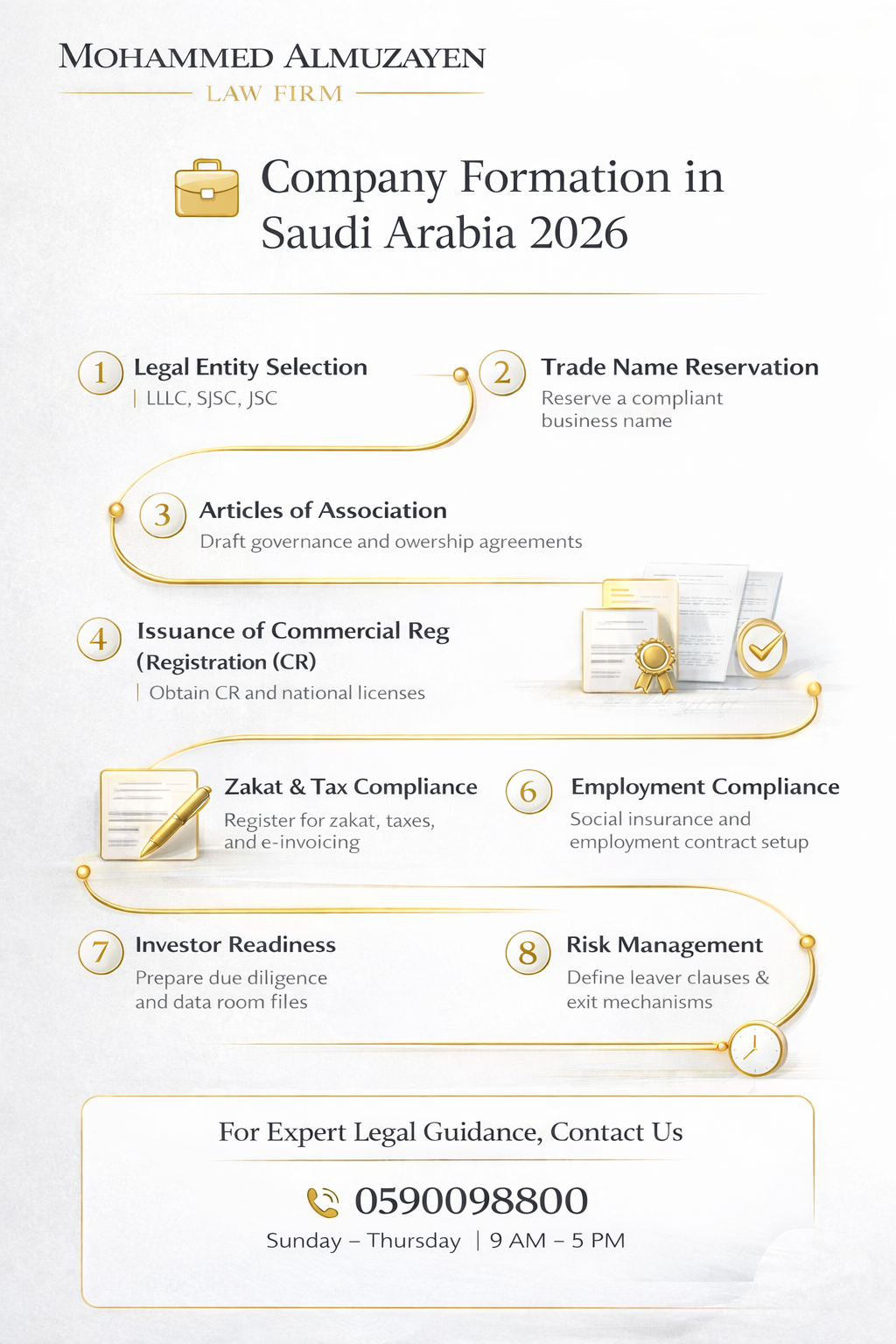
Company formation in Saudi Arabia 2026: incorporation workflow from entity selection to compliance and investor readiness.
About Us
We are a law firm and legal consultancy specialized in company formation in Saudi Arabia and in building compliant legal structures suitable for entrepreneurs and investors. We support our clients from the stage of selecting the appropriate legal entity (limited liability company, simplified joint stock company, or joint stock company), through defining the business activity and required licenses, to drafting the Articles of Association/bylaws with precise legal formulation that protects founders’ rights and mitigates future disputes.
We manage trade name reservation, issuance of the commercial registration, and documentation of incorporation resolutions, while ensuring alignment with ownership structure and governance requirements (including signing authorities and ROFR/Tag/Drag provisions) in a manner that supports investment readiness. We also assist in preparing due diligence documentation and establishing an organized Data Room to ensure a secure regulatory launch and scalable growth that is suitable for financing and expansion.
1) Legal and Regulatory Framework
What legal entity types are available?
Under Saudi law, the most commonly used legal forms are:
-
Limited Liability Company (LLC)
-
Simplified Joint Stock Company (SJSC)
-
Joint Stock Company (JSC)
The choice depends on the nature of the business, number of shareholders, capital requirements, governance expectations, and future investment plans.
Are all activities freely permitted?
Certain business activities require prior approvals or special licenses from competent authorities, particularly in regulated sectors such as finance, insurance, healthcare, education, and technology.
Is foreign ownership allowed?
Foreign ownership is generally permitted, subject to sector-specific restrictions and licensing requirements. Some activities may require minimum capital thresholds or local participation.
What changes are expected in 2026?
Enhanced governance requirements, beneficial ownership disclosure, and closer integration between commercial, tax, and regulatory authorities are expected to continue.
2) Legal Setup and Incorporation Process
What is the first step?
The process begins with reserving a compliant trade name in accordance with Saudi naming regulations.
Why is the Articles of Association critical?
The Articles of Association or bylaws govern shareholder relations, capital structure, management authority, profit distribution, and exit mechanisms. Poor drafting at this stage often leads to disputes later.
What follows incorporation?
-
Issuance of the Commercial Registration (CR)
-
Registration of the National Address
-
Opening official files with relevant government authorities
3) Capital and Ownership Structure
Declared vs. paid-up capital
Declared capital represents the authorized amount, while paid-up capital reflects actual contributions.
Share allocation
Ownership percentages should accurately reflect contributions, roles, and risk allocation among founders.
Founder vesting arrangements
Vesting mechanisms are increasingly used to ensure long-term commitment by founders and protect the company from premature exits.
Transfer restrictions
Share transfers are typically subject to restrictions such as approval requirements, rights of first refusal, and lock-up periods.
4) Governance and Management
Management structures
Depending on the legal form, management may consist of a single manager, a board of managers, or a board of directors.
Signatory authority
Clear delegation of signing authority is essential to avoid internal conflicts and third-party disputes.
Foundational resolutions
Incorporation resolutions and minutes serve as essential legal records from day one.
ROFR, Tag-Along, and Drag-Along rights
These contractual protections regulate ownership transfers and safeguard shareholder interests.
Legal Consultation
5) Banking, Tax, and Financial Compliance
Corporate bank accounts
Banks require a complete incorporation file, identification of beneficial owners, and authorized signatories.
Zakat and tax obligations
Companies must register with the relevant authorities and comply with periodic filing requirements.
E-invoicing compliance
Electronic invoicing is mandatory and requires technical and procedural readiness.
6) Employment and Human Resources
Social insurance registration
Companies must register employees with the social insurance system from the start of operations.
Employment contracts
Contracts must clearly define compensation, duration, confidentiality, and termination terms.
Equity-based incentives
Stock option plans or phantom equity schemes may be implemented, subject to proper legal structuring.
7) Intellectual Property and Technology
Trademark registration
Registering trademarks protects brand identity and market position.
Ownership of code and products
IP ownership must be contractually assigned to the company, especially with developers and consultants.
Confidentiality agreements
NDAs are essential to protect proprietary information and trade secrets.
8) Investor Readiness
Clean capitalization table
A transparent and dispute-free cap table is critical for attracting investors.
Due diligence documentation
Investors expect organized legal, financial, and corporate records within a structured data room.
Investment instruments
Term Sheets, SAFEs, and convertible notes may be used if properly adapted to local legal requirements.
9) Risk Management and Exit Planning
Good Leaver vs. Bad Leaver
These clauses define the financial consequences of a shareholder’s exit.
Dispute resolution mechanisms
Arbitration or litigation forums should be agreed upon in advance.
Exit strategies
Early planning for mergers, acquisitions, or share sales ensures flexibility and value preservation.
Frequently Asked Questions (FAQ)
Can a company be incorporated quickly?
Procedurally yes, but proper legal structuring requires careful preparation.
Is foreign ownership always permitted?
No, some activities remain restricted or conditional.
Is governance mandatory?
Yes, governance requirements vary depending on the legal form.
Can the structure be amended later?
Yes, but amendments often involve higher costs and legal risk.
Conclusion
Company formation in Saudi Arabia 2026 is a comprehensive legal project rather than a simple registration task. Early legal planning, precise drafting of incorporation documents, and strict compliance with governance and regulatory requirements are essential for sustainable growth and successful investment.
Related Articles
Industrial License Renewal (Production) in Saudi Arabia 2026
An in-depth overview of the regulatory requirements and renewal procedures for industrial production licenses in Saudi Arabia, highlighting compliance obligations, renewal timelines, and the legal risks associated with delayed or improper renewal.
Start Your Factory in Saudi Arabia
A practical legal guide explaining the key steps to establish a factory in Saudi Arabia, including regulatory approvals, industrial land requirements, licensing pathways, and compliance considerations for manufacturing and industrial investors.
Summary
Company formation in Saudi Arabia 2026 requires a clear understanding of the legal framework, proper entity selection, structured ownership and governance, and full regulatory and tax compliance. Sound legal preparation from incorporation ensures investor readiness, minimizes risk, and supports long-term business growth.
