
The concept of establishing a holding company in Saudi Arabia has become increasingly relevant for foreign investors seeking long-term, structured entry into the Saudi market. With the Kingdom’s continued economic reforms and openness to foreign investment, questions around holding company registration in Saudi Arabia and the possibility of 100% foreign ownership are frequently raised.
an abstract entitlement. It is a legal outcome that depends on the nature of the entity, the registered activity, and the way the corporate structure is designed. This article explains how foreign ownership works in practice when establishing a holding company in Saudi Arabia, and how 100% foreign ownership can be structured within the applicable legal framework.
What You Will Read in This Article
-
What “100% foreign ownership” really means under Saudi corporate and investment regulations
-
Whether foreign investors can establish a holding company in Saudi Arabia with full ownership
-
The key legal and regulatory differences between holding companies and operating companies in Saudi Arabia
-
Common structuring and compliance issues foreign investors often overlook
-
When a Saudi holding company is the right strategic choice for regional and cross-border structures.
About the Author
Mohammed Al-Muzayen is a Saudi lawyer and arbitrator based in Riyadh, specializing in holding company formation and cross-border corporate structuring for foreign investors. He advises clients operating through Dubai and Abu Dhabi free zone holding entities and supports them in establishing compliant Saudi holding and operating companies aligned with local corporate and investment regulations. With more than fifteen years of legal experience, he provides structuring, governance, and compliance guidance for founders, family offices, and investment funds, including venture capital-related requirements. He holds an LL.B. from King Saud University in Riyadh (2009) and has worked with major national companies, including Almajdouie Group, Binzagr Company, United Mining Investments, Al Mawarid, and Golden Petroleum Investment.
What Does “100% Foreign Ownership” Really Mean in Saudi Arabia?
In Saudi Arabia, foreign ownership is governed by a regulatory framework that focuses on substance rather than slogans. The term “100% foreign ownership” does not function as a blanket rule applicable to all businesses and all activities.
Instead, foreign ownership is assessed based on several factors, including:
-
the type of legal entity being established,
-
the business activity registered with the authorities,
-
the purpose of the company (investment, holding, or operational), and
-
sector-specific regulations where applicable.
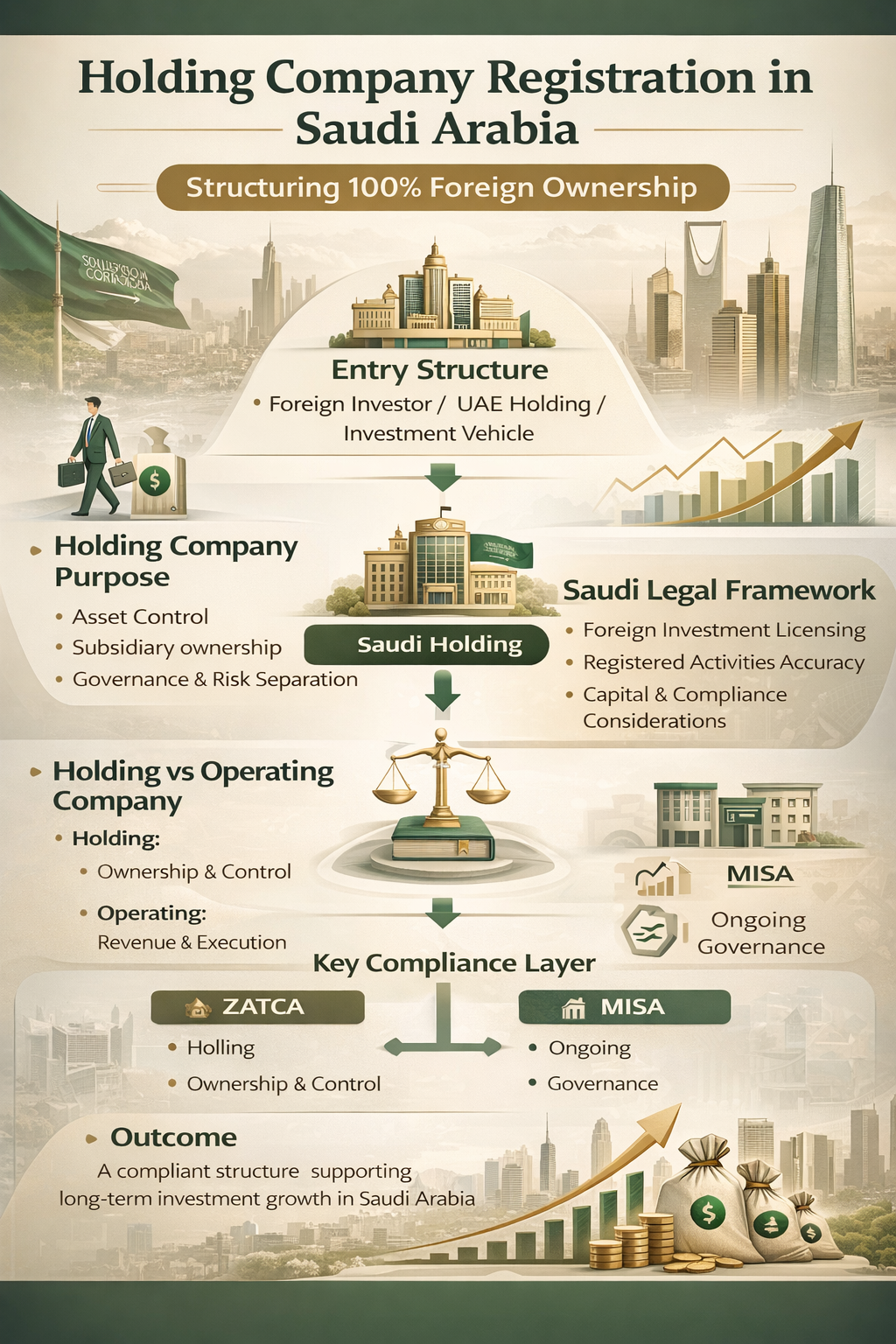
For holding companies in particular, the analysis is different from that of operating companies. A holding company is generally established to own shares, manage investments, and exercise control over subsidiaries rather than to conduct direct commercial operations. This distinction plays a central role in determining ownership permissibility.
Is 100% Foreign Ownership Available for Holding Companies in Saudi Arabia?
In many cases, foreign investors can establish a Saudi holding company with full foreign ownership, provided the company’s purpose and activities are correctly defined and aligned with regulatory expectations.
A Saudi holding company is typically structured as an investment vehicle rather than an operational business. Its core functions may include:
-
owning shares in Saudi or foreign subsidiaries,
-
managing group investments,
-
exercising shareholder control and governance functions, and
-
coordinating strategic decisions at group level.
When structured properly, these activities are often compatible with full foreign ownership. However, the availability of 100% foreign ownership is not automatic. Authorities will look closely at whether the company’s actual activities remain within the scope of a holding entity or drift into operational or regulated sectors that may require additional approvals or impose ownership conditions.
Regulatory Limits Foreign Investors Often Overlook
One of the most common issues faced by foreign investors is not rejection at the incorporation stage, but complications that arise later due to regulatory misalignment.
Typical oversight areas include:
-
registering overly broad activities that conflict with the intended holding function,
-
allowing the holding company to perform operational roles reserved for licensed operating entities,
-
insufficient separation between the holding company and its subsidiaries, and
-
governance documents that do not clearly define authority and control mechanisms.
In Saudi Arabia, compliance is ongoing and operational. A holding company must continue to behave like a holding company in practice, not only on paper. When these distinctions are blurred, regulators and financial institutions may require restructuring, amendments, or additional licensing.
holding company registration saudi arabia, foreign ownership, 100% foreign ownership, corporate structuring, Saudi holding company, MISA, ZATCA
Holding Company vs Operating Company in Saudi Arabia
Understanding the legal distinction between a holding company and an operating company is essential when planning foreign ownership.
A holding company is primarily designed to:
-
own equity interests,
-
manage investments, and
-
exercise strategic control.
An operating company, by contrast, is established to conduct commercial activities, employ staff, enter into contracts, and generate revenue from operations.
Attempting to use an operating company as a de facto holding vehicle often creates regulatory exposure, particularly where foreign ownership is involved. In many cases, separating the two entities provides greater legal clarity, governance flexibility, and long-term compliance stability.
When Does a Saudi Holding Company Make Sense for Foreign Investors?
A Saudi holding company is particularly suitable in scenarios such as:
-
foreign investors planning to own multiple Saudi operating subsidiaries,
-
regional groups structuring investments across several jurisdictions,
-
family offices and investment vehicles seeking centralized ownership, and
-
funds or institutional investors requiring clear governance and asset segregation.
Conversely, a holding structure may be unnecessary or inefficient where the investor intends to operate a single business with no investment layering or future expansion.
Practical Structuring Considerations Beyond Incorporation
Successful holding company registration in Saudi Arabia requires planning beyond the issuance of the commercial registration. Key considerations include:
-
defining the company’s purpose precisely in its constitutional documents,
-
drafting governance provisions that reflect its role as a parent entity,
-
structuring relationships with subsidiaries through clear shareholder arrangements, and
-
preparing for ongoing regulatory, accounting, and compliance obligations.
In this context, incorporation is not the end of the process but the beginning of a long-term legal and regulatory relationship.
Frequently Asked Questions
Can a foreigner own 100% of a company in Saudi Arabia?
Yes, in many cases foreign investors can own 100% of a Saudi company, subject to the company’s activity, structure, and regulatory approvals.
What is the foreign ownership limit in Saudi Arabia?
There is no single universal ownership limit. Limits, where they exist, depend on the sector, the activity, and the applicable regulations.
Can a foreign investor register a holding company in Saudi Arabia?
Yes, foreign investors may register holding companies in Saudi Arabia when the structure and purpose comply with Saudi corporate and investment regulations.
Is a holding company treated differently from an LLC in Saudi Arabia?
A holding company may be incorporated as an LLC, but it is treated differently in terms of purpose, activity scope, and regulatory expectations.
Conclusion
Holding company registration in Saudi Arabia offers foreign investors a structured and flexible way to manage investments within the Kingdom. While 100% foreign ownership is achievable in many cases, it is not a default position. The determining factor is the quality of the legal structure, the accuracy of the registered activities, and the company’s ongoing compliance with Saudi regulations.
When approached as a strategic legal project rather than a procedural formality, a Saudi holding company can provide a stable foundation for long-term investment and growth.
Related Articles
