
Securing your first arbitrator appointment is one of the most critical milestones in any arbitration career. Many qualified professionals struggle not because they lack legal knowledge, but because arbitration appointments are ultimately driven by trust, proven experience, and institutional credibility. If you are asking how to get your first arbitrator appointment?, the answer lies in understanding what appointing parties truly value—and choosing the right professional platform to support that decision.
In Riyadh’s rapidly growing arbitration market, parties increasingly seek arbitrators who combine deep legal expertise, sector-specific experience, and an established professional reputation. This is precisely where Mohammed Almuzayen Law & Arbitration Office positions itself as the first destination for arbitration appointments.
What will you read in this article?
- Why the first arbitrator appointment is often the hardest to secure
- What appointing parties look for when selecting an arbitrator
- Practical pathways to becoming a sole arbitrator, co-arbitrator, or tribunal chair
- Common mistakes that delay or prevent arbitration appointments
- Why appointing through an experienced Riyadh-based arbitration office matters
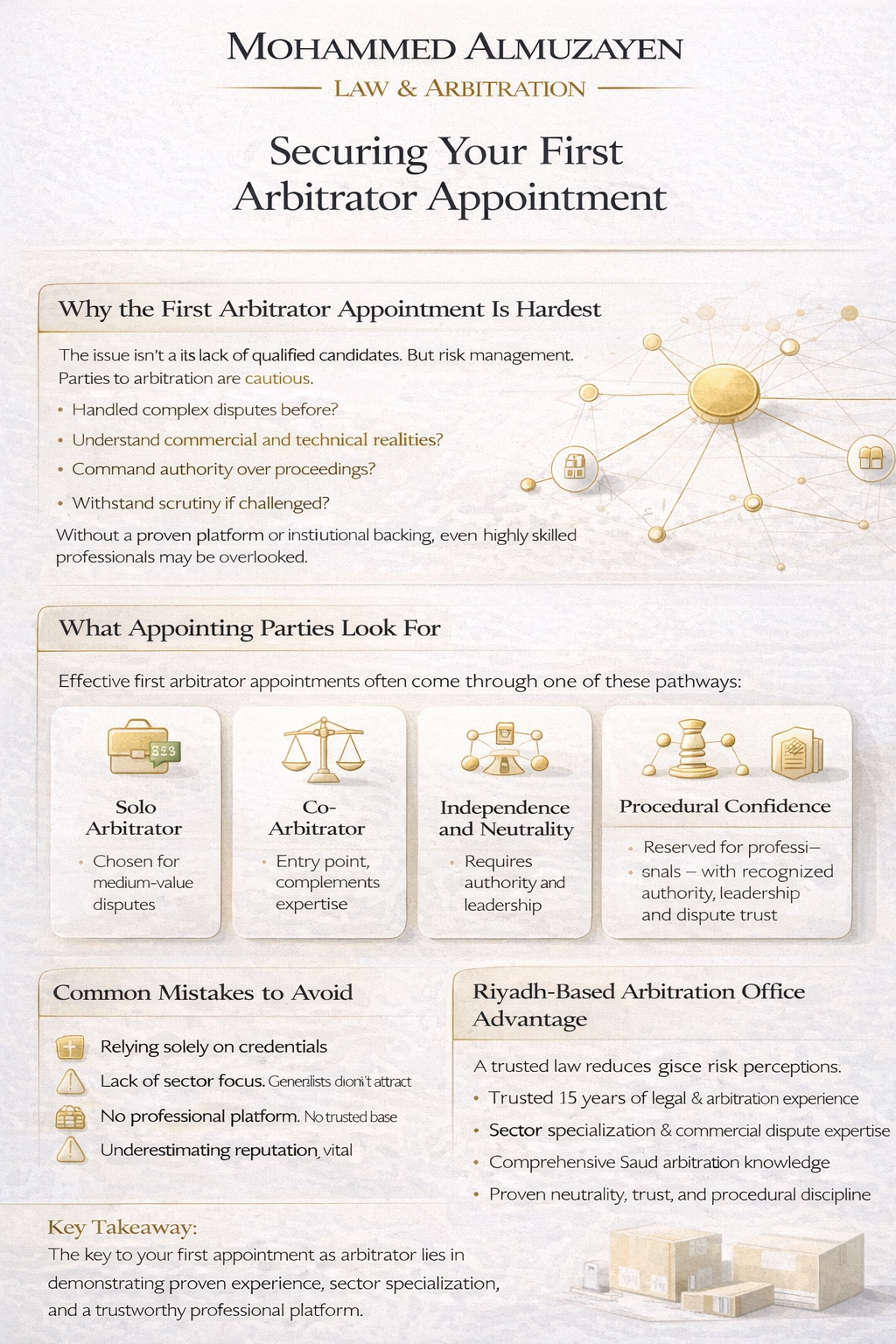
Infographic explaining how to get your first arbitrator appointment, highlighting what appointing parties in Saudi Arabia look for, including experience, neutrality, and procedural confidence. Prepared by Mohammed Almuzayen Law & Arbitration, Riyadh.
Why is the first arbitrator appointment so difficult?
The challenge is not a lack of qualified candidates. The real issue is risk management. Parties to arbitration are cautious. They want certainty that the arbitrator they appoint will manage proceedings efficiently, remain independent, and issue an enforceable and well-reasoned award.
For a first appointment, decision-makers usually ask:
- Has this arbitrator handled complex disputes before?
- Do they understand the commercial and technical realities of the case?
- Can they command authority over the proceedings?
- Will their appointment withstand scrutiny if challenged?
Without a proven platform or institutional backing, even highly skilled professionals may be overlooked.
What do appointing parties really look for (in Saudi Arabia)?
When parties or institutions in Saudi Arabia (KSA) consider an arbitrator—especially for a first appointment—they focus on five core factors that directly affect the case outcome and enforceability in Riyadh and across the Kingdom:
1) Demonstrated Experience (Saudi dispute reality)
In Saudi Arabia, “experience” goes beyond prior arbitral appointments. Appointing parties look for proven hands-on work in Saudi disputes, including:
-
construction claims and project disputes common in KSA mega-projects,
-
commercial litigation and contract interpretation under Saudi practice,
-
negotiations and dispute management in a Saudi business environment.
They want someone who understands how disputes actually unfold in Saudi Arabia—not just arbitration theory.
2) Sector Specialization (KSA construction & government-driven projects)
Arbitration in KSA is highly sector-driven, especially in:
-
construction and infrastructure (the most appointment-heavy area in Saudi Arabia),
-
energy and industrial projects,
-
corporate and commercial contracts with long-term obligations.
Saudi parties prefer arbitrators who speak the “industry language” and understand project documentation, claims, variations, delay analysis, and contractual risk—because this is the daily reality of disputes in Riyadh and the Kingdom.
3) Independence and Neutrality (critical for Saudi enforceability)
In Saudi Arabia, independence is not a “nice-to-have”—it is essential. Parties want arbitrators known for:
-
strict neutrality,
-
clear disclosure practice,
-
strong professional ethics.
This matters because any perceived bias can trigger challenges and complicate the path to recognition and enforcement in Saudi courts.
4) Procedural Confidence (SCCA culture + efficiency expectations)
Saudi arbitration users increasingly value efficiency and procedural discipline, particularly in matters administered through the Saudi Center for Commercial Arbitration (SCCA) or conducted in Riyadh. Decision-makers look for arbitrators who can:
-
control timelines firmly,
-
run hearings professionally,
-
manage submissions and evidence with clarity,
-
keep the process cost-effective and outcome-focused.
In the Saudi market, procedural confidence = reduced delay + reduced cost + higher trust.
5) Professional Credibility (a Riyadh-based trusted platform matters)
In KSA, credibility is often tied to where the arbitrator sits professionally. A reputable Riyadh-based law and arbitration office can materially increase confidence because it signals:
-
established dispute-handling capability in Saudi Arabia,
-
reliable professional standards,
-
familiarity with the Saudi arbitration ecosystem.
That’s why appointing parties in Riyadh often prefer arbitrators connected to a trusted Saudi legal platform—especially for first-time or high-stakes appointments.
Practical pathways to your first arbitrator appointment
There is no single route, but successful first appointments usually come through one of the following pathways:
Sole Arbitrator Appointment
Often chosen in medium-value disputes where parties seek efficiency. Experience and trust are decisive.
Co-Arbitrator Appointment
Frequently used as an entry point, especially when parties want balanced tribunals with complementary expertise.
Chairman of the Arbitral Tribunal
Reserved for professionals with recognized authority, leadership, and dispute management skills.
In all three cases, institutional confidence and professional standing play a decisive role.
Why experience matters more than titles
Many aspiring arbitrators focus on certifications, courses, or titles. While important, these alone rarely secure appointments.
What truly matters is:
- Years of hands-on dispute resolution
- Exposure to high-value and technically complex cases
- Ability to analyze evidence, contracts, and claims with precision
- Confidence to guide parties through contentious proceedings
With over 15 years of legal and arbitration-related experience, Mohammed Almuzayen Law & Arbitration Office offers exactly this depth—built through real disputes, not theory alone.
Common mistakes that delay arbitrator appointments
Understanding what not to do is just as important:
- Relying solely on academic credentials
- Lacking a clear sector focus
- Absence of a credible professional platform
- Underestimating the importance of reputation and referrals
- Attempting to enter arbitration without institutional or office backing
These mistakes often delay appointments for years.
Why Mohammed Almuzayen Law & Arbitration Office is the first choice in Riyadh
In a competitive arbitration environment, appointing parties prefer proven reliability. Mohammed Al-Muzayen Law & Arbitration Office has established itself as a trusted name in Riyadh by combining:
- More than 15 years of legal and arbitration experience
- Specialization in construction, commercial, and contractual disputes
- A strong understanding of Saudi arbitration practice and regional business culture
- Professional integrity, neutrality, and procedural discipline
- The capability to act as sole arbitrator, co-arbitrator, or chairman of an arbitral tribunal
This combination significantly reduces appointment risk for parties and institutions alike.
Legal consultation
For parties seeking to appoint a sole arbitrator, tribunal member, or chairman of an arbitral tribunal in Riyadh, or for professionals exploring structured pathways into arbitration, you may contact Mohammed Almuzayen Law & Arbitration Office for specialized legal and arbitration consultation.
Frequently Asked Questions (FAQ)
How long does it usually take to get a first arbitrator appointment?
There is no fixed timeline. Appointments depend on experience, visibility, and professional credibility.
Is prior arbitration experience mandatory for a first appointment?
Not always, but extensive dispute resolution experience is essential.
Can a lawyer with litigation experience become an arbitrator?
Yes. Many arbitrators begin with strong litigation and dispute backgrounds.
What is the most common entry point for new arbitrators?
Serving as a co-arbitrator or being appointed through a trusted legal office.
Why does the appointing office matter?
A reputable office significantly reduces perceived risk for the parties.
Conclusion
If you are asking how to get your first arbitrator appointment?, the answer is clear: experience, specialization, and credibility matter more than anything else. Arbitration appointments are built on trust, not theory.
By choosing a seasoned, Riyadh-based arbitration office with more than fifteen years of proven legal practice, appointing parties ensure confidence, neutrality, and procedural excellence from the very first step.
Related Articles
-
SCCA Online Arbitration: Appointment and Challenge of the Arbitrator (ODR Appendix – Article 5)
January 3, 2026 | Events & Updates, English Articles
This article examines the legal framework governing the appointment of a sole arbitrator and the mechanism for challenging an arbitrator under the SCCA Online Dispute Resolution (ODR) Procedure Rules, with a particular focus on Article 5 and its impact on case management from the outset. -
Arbitration Clause Drafting and Its Impact on Amicable Settlement in Saudi Construction Contracts
January 3, 2026 | Events & Updates, English Articles
This article analyzes the strategic importance of drafting arbitration clauses in Saudi construction contracts and how well-structured clauses can reduce disputes and enhance the prospects of amicable settlement in complex, long-term projects. -
Arbitration Fees Policy at Mohammed Almuzayen Law Firm & Arbitration
January 3, 2026 | Events & Updates, English Articles
This article outlines the arbitration fees policy adopted by Mohammed Almuzayen Law Firm & Arbitration, addressing cost efficiency and proportionality in arbitration proceedings, particularly in simple or low-complexity disputes. -
ICC Court of Arbitration: Its Institutional Role and the Enforceability of Awards in Saudi Arabia
December 12, 2025 | English Articles
This article explores the institutional role of the ICC Court of Arbitration and examines key considerations relating to the enforceability of ICC arbitral awards in Saudi Arabia. -
Racing Against Time in the Arbitration Hall: Expedited Arbitration before the Saudi Center for Commercial Arbitration (SCCA)
September 11, 2025 | Events & Updates, English Articles
This article discusses expedited arbitration procedures before the SCCA and their practical significance for businesses seeking time-efficient dispute resolution in Saudi Arabia.
Summary
Getting your first arbitrator appointment requires proven dispute resolution experience, sector specialization, and professional credibility. Appointing through an established arbitration office significantly increases trust and reduces risk for parties. Experienced Riyadh-based arbitration practices remain the most reliable gateway to first and repeat arbitrator appointments.
