
Saudi Market Entry 2026: A Legal Roadmap for Digital Investors (MISA, SAMA & CMA)
Entering the Saudi market in 2026 is faster when structured correctly: align your activity with MISA’s instant licensing model, then map regulated digital features to SAMA or CMA pathways. Success depends on investor-grade governance under the New Saudi Companies Law and a sequenced compliance plan designed for scale.
What You Will Learn
- How MISA market entry works in 2026—and what “instant licensing” really means in practice
- Which regulator applies to your digital model: SAMA, CMA, or both
- How to structure a Saudi entity for fundraising, governance, and execution
- How to avoid common compliance traps that delay launch and harm valuation
- Why “local execution” in Riyadh materially improves investor follow-up and speed
About the Author
Mohammed Almuzayen is a lawyer and arbitrator with more than fifteen years of legal experience. He specializes in construction and infrastructure disputes, corporate and commercial disputes, government contracts, and franchise agreements. He holds a Bachelor of Laws degree from King Saud University in Riyadh (2009) and has extensive practical experience advising major national companies, including Almajdouie Group, Binzagr Company, United Mining Investments Company, Al Mawarid (listed joint-stock company), and Golden Petroleum Investment.
Key 2026 Market Entry Insight
Entering the Saudi market in 2026 is streamlined through MISA’s instant licensing model, enabling preliminary market entry rapidly for qualified activities (often within 24 hours). For digital and fintech companies, execution hinges on structured regulatory pathways via SAMA’s Sandbox or the CMA FinTech Lab, combined with VC-ready governance aligned with the New Saudi Companies Law.
1) Market Entry in 2026: Think in Sequences, Not Steps
Saudi Arabia’s 2026 investment environment is no longer about “filling forms.” It is about sequencing: licensing first, regulated features next, then operational readiness—so you launch without redesigning your product or restructuring your cap table mid-way.
The investors who move fastest are those who start with three questions:
- What is the correct activity classification and licensing path?
- Which regulator applies to the revenue-critical features (payments, lending, investment, custody, crowdfunding)?
- Is the governance structure “fundable” and enforceable locally?
2) MISA 2026: From Traditional Approvals to Instant Licensing Logic
2.1 What “Instant Licensing” Actually Means
In 2026, MISA’s model emphasizes post-licensing compliance: you can obtain a preliminary license quickly when the activity is correctly classified and the file is ready.
Practical reality: speed is not luck. Speed is documentation discipline.
2.2 Incentive Mapping Before You Apply
Incentives are not a slogan. They are a function of:
- sector priority,
- economic contribution,
- and execution readiness.
A serious entry file is built to answer:
Why does this project belong in Saudi Arabia—and why is it investable now?
2.3 Entity Selection: LLC vs Branch vs RHQ (Investor Logic)
Your entity choice must match your funding plan and risk profile—not only setup convenience.
- LLC (Limited Liability Company): common for operating companies; flexible governance and local execution
- Branch: extends a foreign parent; useful for certain corporate strategies, but can create reporting/commitment expectations
- RHQ (Regional Headquarters): relevant for group-level planning and regional footprint structuring
Common mistake: selecting an entity first, and thinking about funding later. The order should be reversed.
Legal Consultation (CTA)
For structured legal guidance on Saudi market entry in 2026—activity classification, licensing alignment, fintech pathways, and investor-ready governance—you may contact Mohammed Almuzayen Law Firm in Riyadh (Anas Bin Malik Road). Call: +966590098800
3) Digital & Fintech: The Regulator Map Investors Must Get Right
Not every “tech” company is regulated. But many digital models become regulated the moment they touch:
- customer funds,
- payments and wallets,
- lending or credit decisions,
- investment promotion or crowdfunding,
- capital markets distribution.
Your regulatory classification must be driven by features, not by marketing labels.
4) Fintech & Venture Capital Structuring (Operations Manual)
4.1 SAMA Sandbox vs CMA FinTech Lab: Which One Fits?
Saudi Arabia’s controlled innovation channels are designed to let qualifying firms test products in a supervised environment.
- SAMA Sandbox is typically relevant when the product is fundamentally financial infrastructure—payments, wallets, lending models, or related financial rails.
- CMA FinTech Lab is typically relevant when the product touches investment activity—crowdfunding, investment platforms, securities-related workflows, or investor-facing capital markets features.
Execution principle: do not “pick a regulator.”
Map your features and revenue flows, then determine the correct path.
4.2 What VCs Actually Underwrite (Beyond the Pitch)
International investors assess three readiness pillars:
- AML/KYC readiness (non-negotiable)
Clear onboarding, transaction monitoring, escalation, and reporting mechanics. - Governance that survives scrutiny
Who can sign? Who approves product changes? How are risks escalated?
Weak governance is the fastest route to delays. - Operational resilience
Audit readiness, cybersecurity posture, and data control—so regulatory review does not interrupt growth.
4.3 VC Term Sheets: Preserve Global Protections, Make Them Locally Enforceable
Term sheets often include:
- drag-along and tag-along rights
- anti-dilution mechanics
- liquidation preferences
- founder vesting and exit rights
The goal is not to remove these provisions. The goal is to translate them into Saudi-enforceable implementation—with clarity on governance, dispute resolution strategy, and documentation integrity.
4.4 Dual Structuring: Offshore Capital + Saudi Execution
Many ventures operate with:
- an offshore holding vehicle (for investor arrangements and capital raising), and
- a Saudi operating company (for licensing, hiring, contracting, and revenue execution).
Done correctly, this preserves investor protections while enabling clean local operations. Done poorly, it triggers friction later—especially at follow-on rounds and exits.
4.5 The Finishing Touch (Local Execution Advantage)
At Mohammed Almuzayen Law Firm, we apply this level of regulatory and venture structuring from our strategic base on Anas Bin Malik Road in Riyadh. Our proximity to the key business ecosystem in Al Malqa and Al Yasmin supports timely, practical follow-up—grounded in local execution, not theoretical guidance.
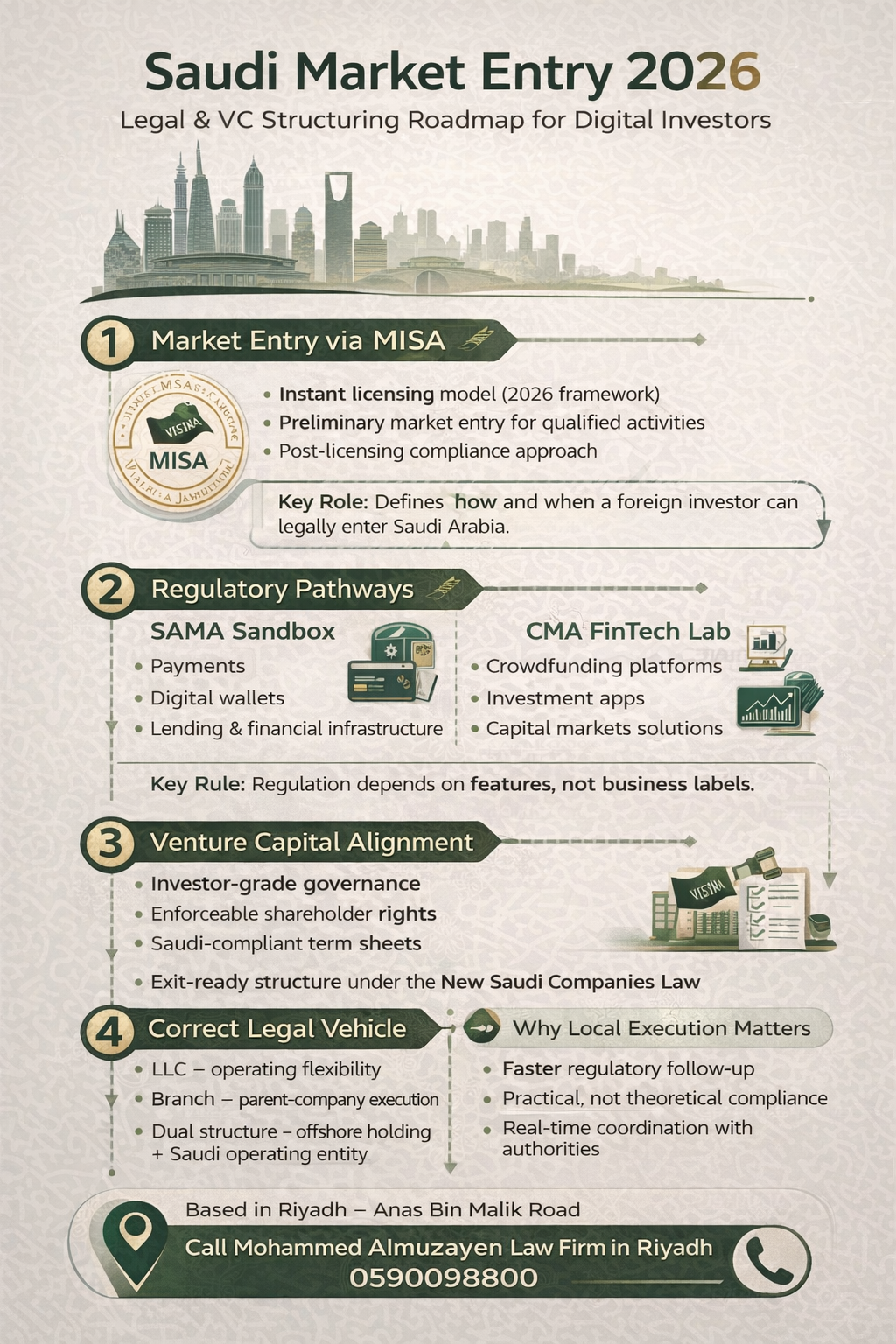
Saudi Market Entry 2026 roadmap for digital investors (MISA + SAMA + CMA). Need a compliant entry plan? Call Mohammed Almuzayen Law Firm in Riyadh: 0590098800
5) The Authority Layer: Why This Roadmap Works
This roadmap is built for execution, not commentary:
- it sequences licensing, regulatory mapping, and governance to reduce rework,
- it focuses on investor-ready structuring to protect valuation,
- and it anticipates compliance expectations before launch.
6) Transparency: Indicative Timeline & Cost Logic (High-Level)
Investors value clarity. Below is a practical planning view (actual outcomes vary by activity, readiness, and regulator):
| Stage | What It Covers | Typical Timeline Range |
|---|---|---|
| Entry planning | Activity mapping + structure + governance | 1–2 weeks |
| MISA licensing | Preliminary license for qualified activities | Rapid (often within 24 hours) |
| Regulated pathway | Sandbox / approvals (if applicable) | Case-dependent |
| Go-live readiness | Contracts + hiring + compliance operations | Structured per regulator |
Important: the fastest projects are the most prepared, not the most aggressive.
Frequently Asked Questions (FAQ)
1) Do I need a Saudi partner in 2026?
In many sectors, 100% foreign ownership is available. The correct approach is to confirm activity classification and licensing requirements before committing to a structure.
2) Which regulator applies to my digital business: SAMA or CMA?
It depends on the features. Payments, wallets, and certain finance rails often point to SAMA. Investment platforms, crowdfunding, and capital-markets-related activities often point to CMA. Some models require careful sequencing across both.
3) Can a fintech test in Saudi Arabia before full licensing?
In qualifying cases, yes—through supervised innovation channels (such as sandbox/lab pathways), provided the file demonstrates risk controls, governance readiness, and a credible graduation plan.
Conclusion
Saudi market entry in 2026 is achievable—and fast—when you treat licensing and regulation as a sequenced operating plan, not a one-time application. For digital investors, the core advantage comes from mapping features to the correct regulator early, structuring governance to VC standards, and executing with documentation discipline from day one.
Call to Action
Don’t navigate Saudi Vision 2030 alone. Connect with Mohammed Almuzayen Law Firm for a compliant, strategic market entry plan designed for execution and investment readiness. Call: +966590098800
Summary
This article explains how investors enter the Saudi market in 2026 through MISA’s instant licensing model and how digital firms sequence regulated activities via SAMA or CMA pathways. It also outlines VC-ready governance under the New Saudi Companies Law. This roadmap reflects the practical experience of Mohammed Almuzayen Law Firm in Riyadh located on Anas Bin Malik Road, serving investors and business owners in Al Malqa, Al Yasmin, Hittin, and Al Ghadir.
