
In SCCA online arbitration under the ODR Procedure Rules, Article 5 governs two issues that shape the case from the outset: (i) appointment of a sole arbitrator, and (ii) the mechanism and deadline for any challenge. Because the procedure runs through the ODR Platform and operates on shortened timelines, parties must treat arbitrator disclosures and challenge deadlines as an immediate procedural priority.
This article offers a practical reading of Article 5 of the ODR Appendix, focusing strictly on what the rule establishes: who appoints the arbitrator, what must be disclosed and when, how disclosures circulate, when the challenge window opens, and what the SCCA Court may decide.
What this article covers
-
How the sole arbitrator is appointed under Article 5(1)
-
The disclosure standard and the duty of prompt disclosure if circumstances arise later
-
How disclosures are transmitted to all parties
-
The challenge mechanism under Article 5(2) and the two-business-day deadline
-
The procedural effect of no challenge, and what happens if a challenge is submitted
Author
Mohammed Almuzayen is an attorney and arbitrator with over fifteen years of experience in construction disputes, government contracts, and commercial arbitration. He advises and represents corporate clients in institutional arbitration, including proceedings administered by SCCA.
1) Appointment of the sole arbitrator in SCCA online arbitration
Under Article 5(1), the SCCA Court shall promptly appoint a sole arbitrator. The appointment is paired with a disclosure requirement: the appointed arbitrator must disclose any circumstances that may give rise to justifiable doubts as to impartiality or independence.
Key point: Article 5(1) is designed to ensure that the tribunal is formed quickly while requiring early transparency on neutrality-related circumstances.
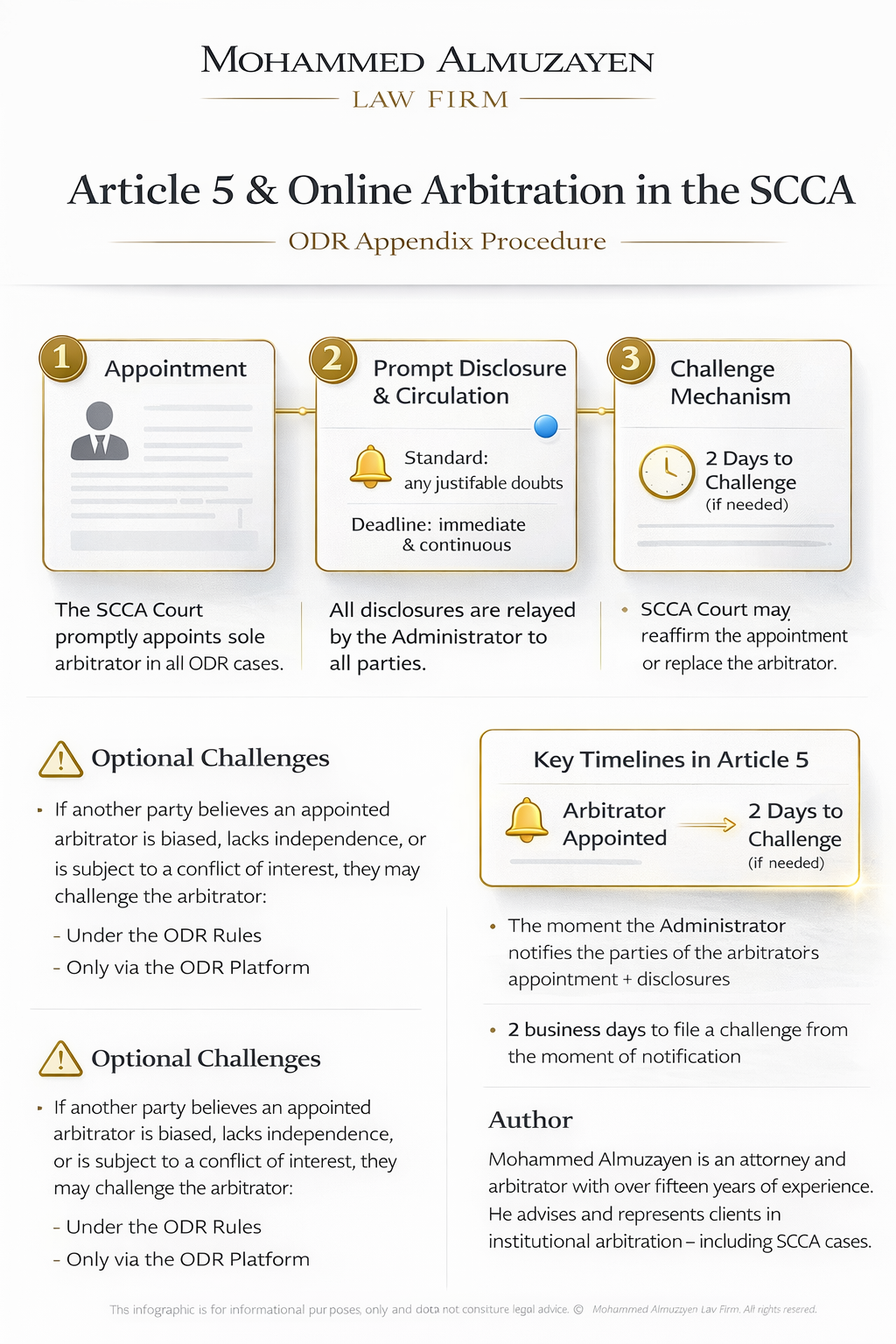
Mohammed Almuzayen Law Firm infographic summarizing Article 5 (ODR Appendix): appointment, disclosure, and challenge timeline in SCCA online arbitration.
2) Disclosure standard and continuity of disclosure in SCCA online arbitration
Article 5(1) uses an objective threshold: disclosure is required for circumstances that may give rise to “justifiable doubts” regarding impartiality or independence.
Importantly, the rule also addresses what happens after appointment. If circumstances arise later that may give rise to such doubts, the Arbitral Tribunal or a party must promptly disclose that information to the Administrator and all parties.
Practical implication (within the limits of the text): parties should not treat disclosure as a one-time event at appointment—Article 5(1) expressly anticipates later-arising circumstances and imposes a prompt disclosure duty when they occur.
3) Role of the Administrator in circulating disclosures in SCCA online arbitration
Article 5(1) places the Administrator at the center of the communications loop. Once the Administrator receives such information from the Arbitral Tribunal or a party, the Administrator shall communicate it to all parties.
Operationally: disclosure does not remain “between” one party and the tribunal; Article 5(1) requires circulation so that all parties are placed on equal notice of the disclosed circumstances.
4) What is a “challenge” under Article 5(2)?
Article 5(2) regulates “Any challenge of the Arbitral Tribunal.” In the ODR context, the tribunal is a sole arbitrator, but the rule’s defined procedural act remains a challenge of the Arbitral Tribunal.
A challenge, in this framework, is the formal procedural step by which a party contests the tribunal’s continuation on grounds connected to the circumstances disclosed under Article 5(1). It is not a merits argument and it is not a review of the tribunal’s decisions; it is a procedural mechanism tied to impartiality and independence concerns as reflected in the disclosure framework of Article 5(1).
5) Deadline, platform, and trigger for the challenge window
Article 5(2) is strict on how and when a challenge must be made:
-
A challenge shall be transmitted using the ODR Platform
-
The deadline is within two business days
-
The two-business-day period runs from the Notice by the Administrator to the parties of:
-
the Arbitral Tribunal’s constitution, and
-
the circumstances disclosed
-
This trigger matters: the clock is tied to the Administrator’s Notice covering both the tribunal’s constitution and the disclosed circumstances.
6) What happens if no challenge is submitted by the deadline?
Article 5(2) states the procedural consequence clearly: absent any challenge by the deadline, the Arbitral Tribunal shall be reaffirmed.
Practical implication (kept faithful to the text): reaffirmation stabilizes the tribunal’s constitution after the short challenge window tied to the disclosed circumstances referenced in the Administrator’s Notice.
7) What happens if a challenge is submitted?
If a challenge has been submitted:
-
The Administrator shall invite the other party to submit comments.
-
The SCCA Court then decides at its discretion whether to reaffirm the Arbitral Tribunal or replace it.
Article 5(2) is explicit that the decision is discretionary for the SCCA Court, and it identifies only two outcomes at that stage: reaffirmation or replacement.
8) Subsequent circumstances after reaffirmation
Even after reaffirmation, the disclosure framework in Article 5(1) remains relevant: if later circumstances arise that may give rise to justifiable doubts, the Arbitral Tribunal or a party must promptly disclose the information to the Administrator and all parties, and the Administrator must communicate it to all parties upon receipt.
Practical note (without adding new rules): any later procedural steps would need to be assessed within the applicable rules framework, but Article 5(1) itself clearly preserves the duty of prompt disclosure for later-arising circumstances.
Legal Advisory
Mohammed Almuzayen Law Firm provides legal advisory services on the application of SCCA Rules, particularly in online arbitration under the ODR Appendix, including tribunal appointment, disclosure handling, and challenge submissions via the ODR Platform. The firm approaches this stage with a procedural strategy focused on timely assessment of disclosed circumstances and correct use of the ODR mechanism from the first Administrator Notice.
Conclusion
Article 5 of the ODR Appendix sets a fast, disclosure-driven process: the SCCA Court promptly appoints a sole arbitrator, relevant circumstances must be disclosed and circulated, and any challenge must be transmitted through the ODR Platform within two business days from the Administrator’s Notice of the tribunal’s constitution and the disclosed circumstances. In a procedure built for speed and finality, this early stage is where parties must act with the greatest procedural accuracy.
Related Articles
-
Arbitration Clause Drafting and Its Impact on Amicable Settlement in Saudi Construction Contracts
-
Arbitration Fees Policy at Mohammed Almuzayen Law Firm & Arbitration
-
Termination of Construction Contracts under Saudi Law: When Can a Company Lawfully Terminate
-
Holding Company Registration in Saudi Arabia | Structuring 100% Foreign Ownership
Summary
This article explains the appointment and challenge mechanism under Article 5 of the ODR Appendix in SCCA online arbitration, covering the prompt appointment of a sole arbitrator, disclosure duties (including later-arising circumstances), the Administrator’s role in communication, the two-business-day challenge deadline via the ODR Platform, and the SCCA Court’s discretion to reaffirm or replace the tribunal.
